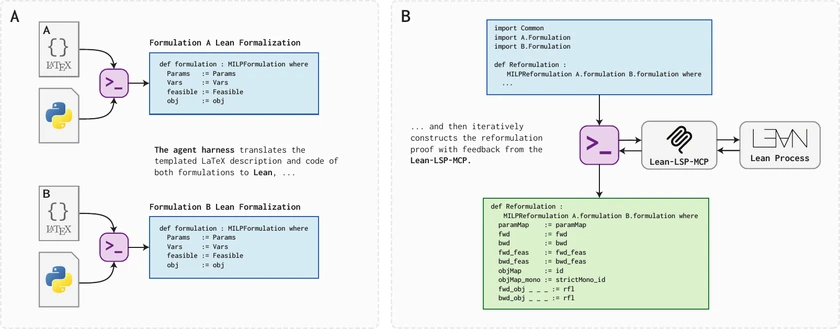
Mixed-Integer Linear Programming (MILP) is a fundamental tool for combinatorial optimization with extensive real-world applications. A central challenge is designing computationally efficient MILP formulations. Large Language Models (LLMs) offer new opportunities to automate the modeling process, from deriving formulations to strengthening them. Reliable automation requires robust methods for verifying that proposed formulations preserve the underlying optimization problem. However, existing approaches evaluate formulations numerically and fail to reason about general problem instances. We resolve this limitation by introducing a constructive definition of MILP reformulation that can be formalized in Lean and machine-checked. We develop FLARE (Formulation-Level Automated Reformulation Evaluation), a method that uses an LLM-based agent and the Lean proof assistant to verify proposed reformulations against a reference formulation. To evaluate our approach, we introduce FormulationBench, a challenging dataset of 20 problems and 109 formulations. FLARE outperforms existing methods, with 100% accuracy on the NP-hard subset of FormulationBench. Furthermore, FLARE produces a machine-checkable certificate for every reformulation it accepts. For cases where formal guarantees are not necessary, we introduce FLARE-NL, a fast and cheap LLM proxy that matches FLARE’s accuracy but produces no certificate. These methods enable reliable verification in automated optimization modeling.
The Simplex algorithm for solving linear programs — one of Computing in Science & Engineering’s top 10 most influential algorithms of the 20th century — is an important topic in many algorithms courses. While the algorithm relies on intuitive geometric ideas, the computationally-involved mechanics of the algorithm can obfuscate a geometric understanding. In this paper, we present gilp, an easy-to-use Simplex algorithm visualization tool designed to connect the mechanical steps of the algorithm with their geometric interpretation. We provide an extensive library of example visualizations, and our tool allows instructors to quickly produce custom interactive HTML files for students to experiment with the algorithm (without requiring students to install anything!). The tool can also be used for interactive assignments in Jupyter notebooks, and has been incorporated into a forthcoming Data Science and Decision Making interactive textbook. In this paper, we first describe how the tool fits into the existing algorithm visualization literature: how it was designed to facilitate student engagement and instructor adoption, and how it substantially extends existing algorithm visualization tools for Simplex. We then describe the development and usage of the tool, and report feedback from its use in a course with roughly 100 students. Student feedback was overwhelmingly positive, with students finding the tool easy to use: it effectively helped them link the algebraic and geometrical views of the Simplex algorithm and understand its nuances. Finally, gilp is open-source, includes an extension to visualizing linear programming-based branch and bound, and is readily amenable to further extensions.
